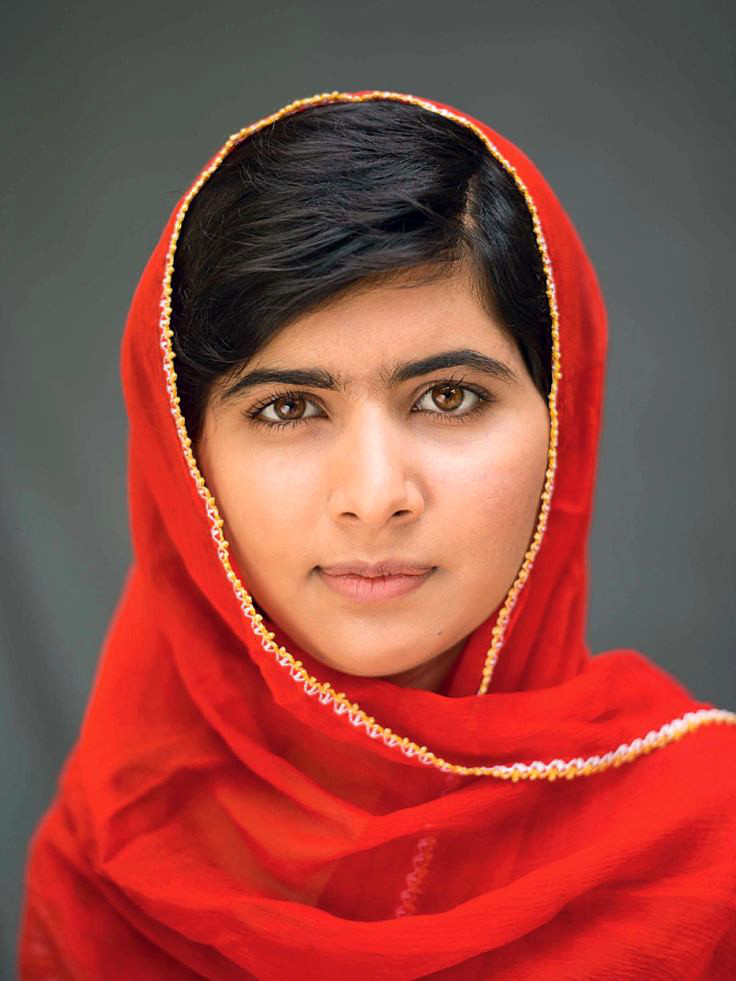
Malala Yousafzai
– Malala is a Pakistani activist for female education, and the youngest-ever Nobel Prize laureate
– She is fluent in multiple languages
– She has been speaking out about education rights since as early as the age of 11, and by age 12, she began as a trainee and then a peer educator in the Institute for War and Peace Reporting’s Open Minds Pakistan youth program, which worked in schools in the region to help young people engage in constructive discussion on social issues through the tools of journalism, public debate and dialog
– To cover the Taliban’s growing influence in Swat, Malala anonymously blogged about her life under a byline for BBC news at the age of 11, documenting her experience with female education being banned and her home being destroyed around her
– Following Malala’s work with BBC, she was approached by a New York Times reporter about filming a documentary
– She started advocating very publicly for female education, speaking out on radio stations and television
– From 2009 to 2010 Malala was the chair of the District Child Assembly of the Khpal Kor Foundation
– In October 2011, Archbishop Desmond Tutu, a South African activist, nominated her for the International Children’s Peace Prize of the Dutch international children’s advocacy group KidsRights Foundation, and though she did not win, she was the first Pakistani girl to be nominated for the award
– She was awarded Pakistan’s first National Youth Peace Prize, and at the proceedings in her honor, Malala stated that she was not a member of any political party, but hoped to found a national party of her own to promote education
– The prime minister directed the authorities to set up an IT campus in the Swat Degree College for Women at Yousafzai’s request, and a secondary school was renamed in her honor
– By 2012, Malala was planning to organize the Malala Education Foundation, which would help poor girls go to school
– That same year, Malala was shot by a masked Taliban gunman because of her outspoken work, but through extensive medical care, survived and has made an impressive recovery
– The murder attempt was met with worldwide reaction, covered by widespread media and addressed by high-profile people (political leaders, celebrities, scholars), many of whom took action in response, such as through donations to The Malala Fund or by publicly showing their support
– She was not deterred by her attack, continuing to speak out; she has spoken before the United Nations, at higher institutions like Harvard, and to Barack Obama and his family directly
– The United Nations deemed July 12 2013, Malala’s 16th birthday, “Malala Day,” as she called for worldwide access to education in her first public speech since the attack, leading the first-ever Youth Takeover of the UN, with an audience of over 500 young education advocates from around the world
– Her memoir I Am Malala: The Story of the Girl Who Stood Up for Education and was Shot by the Taliban, co-written with British journalist Christina Lamb, was published in October 2013
– She also authored a picture book, Malala’s Magic Pencil
– On her 18th birthday, she opened a school in the Bekaa Valley, Lebanon, near the Syrian border, for Syrian refugees; the school is funded by the not-for-profit Malala Fund, and offers education and training to girls aged 14 to 18 years
– Malala was accepted to study Philosophy, Politics and Economics at the University of Oxford

 Water Witches